


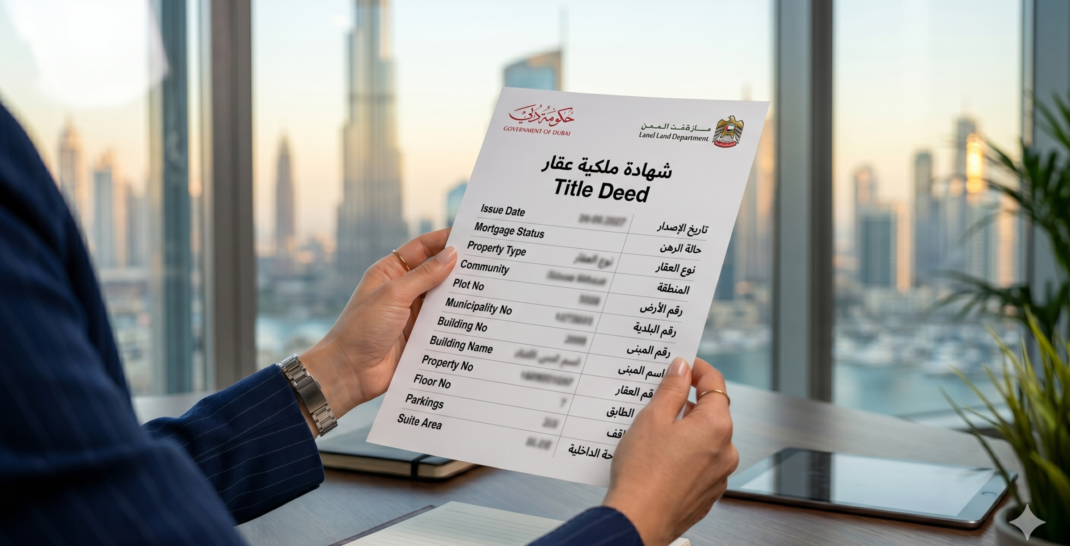
Three terms. One property. Entirely different implications. Here’s how to tell them apart.
By Gabrielle Pillay, Managing Director · TrueGuard Real Estate Consulting
If you’ve ever bought, sold, or advised on an off-plan property in Dubai, you’ve almost certainly encountered these terms. You may have used them yourself. And there’s a reasonable chance that at some point, they were used incorrectly.
Oqood. Initial Contract of Sale. Pre-Title Deed. Title Deed. These are not four different names for the same thing. They represent four distinct stages in the life of a Dubai property — and confusing them leads to real consequences: wrong advice given to clients, transfers that stall at the Trustee Office, mortgage applications that hit unexpected walls, and resale expectations that don’t match reality.
So let’s clear it up — simply, accurately, and once and for all.
“In Dubai real estate, the document tells you where you actually stand. Not where you think you stand.”
THE BIG PICTURE FIRST
Think of it this way: an off-plan property doesn’t arrive in the world with a Title Deed. It earns one — through a series of registration stages that mirror where the project is in its construction and handover lifecycle. Each stage comes with its own document, its own rights, and its own limitations.
Stage 01
Oqood / Initial Contract of Sale
Property is under construction. Your purchase is registered with the DLD in the Interim Property Register. You have a legally recognised contractual right to a future asset — not yet full ownership of a physical property.
Stage 02
Pre-Title Deed
Project is nearing or has reached completion. Transitional ownership stage — handover may have occurred, but final registration is pending due to outstanding payments or administrative processing.
Stage 03
Title Deed
Property is complete. All financial obligations are settled. Ownership is fully and finally registered in the DLD’s main Property Register — the definitive document of legal ownership.
These aren’t competing documents. They’re chapters in the same story — and knowing which chapter you’re in determines what you can and can’t do with the property.
STAGE 01
Oqood — your registered interest, not yet your title
When you buy directly from a developer during the construction phase, your Sale and Purchase Agreement (SPA) is registered with the DLD through a system called Oqood — which simply means “contracts” in Arabic. Introduced by RERA and operated through the DLD, the system exists to do something very specific: prevent developers from selling the same unit twice and ensure every off-plan transaction is officially on record from day one.
Once the mandatory DLD registration fee is paid, the system generates an official Oqood certificate. Your unit is entered into what’s known as the Interim Property Register, and from that point, your purchase is legally recognised by the government.
What Oqood tells you: your purchase is on official record. Your payment plan is documented. Your interest is protected under Dubai law, tied to a RERA-approved project with an active escrow account. The developer cannot sell your unit to someone else.
What Oqood doesn’t tell you: that you own a physical property outright. You own a government-backed, legally protected right to a future asset. The building may still be under construction, awaiting handover, or undergoing final completion. The certificate reflects your contractual standing — not the physical state of the property.
You’ll also hear the term Initial Contract of Sale used in the same breath as Oqood, and often interchangeably. In practice, “Oqood” refers to the DLD’s interim registration system and the certificate it produces, while “Initial Contract of Sale” refers to the registration category tied to it. For most buyers and agents, the terms describe the same stage.
One thing that surprises many people: if a property under Oqood is resold before the project is complete, the new buyer doesn’t automatically receive a Pre-Title Deed. The transfer at the DLD Trustee Office is processed under the Initial Contract of Sale category — the original investor’s Oqood certificate is cancelled, and a brand-new Oqood certificate is issued to the new buyer, who steps into the same interim registration framework and assumes the remaining installments. The word “initial” refers to the project’s registration stage, not to whether this is the first time the property has been sold. A resale can legally remain within the Oqood structure.
Stage 02
Pre-Title Deed — closer to the finish line, but not quite there
The Pre-Title Deed is a transitional document — a bridge between the interim registration of Oqood and the finality of a fully issued Title Deed. Understanding why it exists makes it much easier to understand what it means in practice.
It typically appears under two distinct conditions. The first is a post-handover payment structure: you’ve collected your keys, completed a snagging inspection, and moved into the property — but you’re still on a post-handover payment plan, with perhaps 30% to 50% of the purchase price still outstanding. Because you haven’t fully settled with the developer, the DLD will not issue a final Title Deed until the account is cleared. The Pre-Title Deed bridges that gap.
The second is administrative processing lag: the developer has secured the Building Completion Certificate (BCC) from the municipality — confirming the building is physically complete and approved — but the individual unit sub-plots within the DLD’s central registry are still being administratively separated and processed. The property is done. The paperwork is catching up.
Here’s the misconception that causes the most confusion: many buyers assume that a Pre-Title Deed means the property is complete and the keys are ready. That’s not always true. Because developer workflows and phased community construction vary, a property can move into pre-title registration status while final utility connections or community handovers are still being concluded. It is a registration status — not a structural occupancy guarantee.
For agents advising on resale: the ownership stage directly shapes the transfer process. A property under Oqood follows a different path than one at Pre-Title Deed stage, which differs again from a completed Title Deed. The NOC requirements, Trustee Office documentation, and applicable procedures all shift depending on where the property sits in its lifecycle. Establishing the registration status before listing — not after — is the only way to set accurate expectations for your client.
Stage 03
Title Deed — the document that ends the conversation
The Title Deed — Shehada Mulkiya — is the final, definitive record of property ownership in Dubai. Issued by the DLD from its main Property Register, it is the document every Oqood and Pre-Title Deed is ultimately working toward.
A Title Deed is issued only when three conditions are met: the building is fully complete and approved by all relevant civil authorities; the buyer has settled 100% of their financial liability to the developer; and the provisional off-plan file has been officially closed and transferred to the main register.
Once a Title Deed is in hand, the property is classified as a ready asset — and that classification changes what’s possible. Standard retail mortgages from mainstream UAE banks can be registered against it using the physical property as collateral. The property can be listed on the Ejari system for immediate, legally regulated rental income. And for investors seeking a 10-year Golden Visa through property (requiring a minimum AED 2 million property value), a final Title Deed provides the most straightforward pathway to eligibility.
It’s also the document that produces the cleanest transaction when it comes to resale. The closer a property is to a clear, unencumbered Title Deed, the fewer the complications at the Trustee Office.
One more distinction worth knowing
Not all Title Deeds are the same — freehold vs. leasehold
Full Ownership
Freehold Title Deed
You own the property and the land it sits on — indefinitely. No expiry, no conditions attached to the land itself. You can sell, lease, occupy, or pass it on without restriction. This is the most complete form of property ownership available in Dubai and the type most international investors seek out.
Time-Limited Ownership
Leasehold Title Deed
You own the property for a defined period — typically up to 99 years. During that time, you have the right to use, occupy, and in many cases lease the property. However, the land itself remains the property of the developer or the government. At the end of the lease term, ownership reverts.
In practice, freehold ownership is available to all nationalities within designated freehold zones across Dubai — areas like Downtown Dubai, Dubai Marina, Palm Jumeirah, and Jumeirah Village Circle, among many others. Leasehold arrangements are more commonly found in areas where land ownership remains with a master developer or a government entity, and where buyers are effectively purchasing long-term use rights rather than outright ownership of the plot.
For most buyers, the distinction becomes most relevant at two moments: when financing the purchase, as banks treat freehold and leasehold properties differently in their underwriting; and at resale, where the nature of ownership can affect buyer appetite and achievable price. Understanding which type of Title Deed a property will ultimately carry — before the MOU is signed — is not a small detail.
Worth checking: the type of ownership — freehold or leasehold — should be clearly identified in the Sale and Purchase Agreement and confirmed again when the Title Deed is issued. If there is any ambiguity about which applies to a specific property, that question belongs at the conveyancing stage, not after the fact.
Why the confusion persists
It’s not ignorance. The system genuinely isn’t uniform.
Even experienced professionals get this wrong sometimes — and the honest reason is that Dubai’s off-plan market doesn’t follow a single identical process across every developer. Some developers transition projects from Oqood to pre-title at a different pace. Some developers use terminology in their own communications that doesn’t align neatly with DLD language.
The result: two properties at ostensibly the same stage of construction can sit at entirely different registration points. And the buyer or agent who assumes their situation mirrors someone else’s experience may be working from the wrong map entirely.
There is no universal rule that applies identically across every Dubai development. What there is: the ability to check, verify, and understand exactly where a specific property sits — before advice is given or a transaction is started.
At a glance — what each stage actually means
| Feature | Oqood | Pre-Title Deed | Title Deed |
|---|---|---|---|
| Property status | Under construction / off-plan | Nearing or at completion | Fully complete and ready |
| DLD register | Interim / Provisional | Transitional | Main Property Register |
| Financial state | Active installment plan | Post-handover plan or pending final clearance | 100% paid and settled |
| Mortgage access | Off-plan specialist lenders only | Conditional — subject to bank underwriting | Fully eligible — all UAE lenders |
| Resale process | Can remain within Oqood framework | Specific pre-title transfer process | Standard secondary market transfer |
| Rental / Ejari | Not yet available | Conditional on handover status | Fully available |
| Golden Visa eligibility | Possible (AED 2M+ value) | Possible (AED 2M+ value) | Clearest, most direct pathway |
“The paperwork doesn’t lie. Understanding what each document actually means — before a deal is agreed — is one of the most valuable things anyone involved in Dubai real estate can do.”
If you’re ever unsure about where a property sits in its registration lifecycle, or what that means for a transaction you’re involved in, that’s exactly the kind of question a conveyancer should be able to answer clearly — before it becomes a problem at the Trustee Office.
Work With TrueGuard
Not sure where your property stands? Let’s find out together.
TrueGuard works with buyers, sellers, and agents across every stage of the ownership lifecycle. Reach us at +971 50 398 9513 or trueguardconveyancing@outlook.com — or visit trueguard.ae to learn more.